How Often Should I Use Red Light Therapy?

Many people are becoming interested in the therapeutic benefits of red light therapy. And one of the first questions they ask is, “How often should I receive red light therapy (RLT)?” Many of us have a wide range of health conditions. There are so many different at-home RLT products. And we all have different individual life circumstances as well. So it is no surprise that the answer is, “It depends.”

What does it depend upon? Here are four factors to consider when determining how often to treat yourself with red light or low-level light therapies (LLLT).

Factor #1: Your Health Condition, and Why You’re Seeking a Remedy

The scientific and medical community has extensively research red light therapy. The health conditions tested include:

  • improving skin feel and appearance
  • repairing skin damage
  • reducing fat tissue and slimming body lines
  • improving mental and cognitive states
  • accelerating recovery from surgeries and injuries

Every year, doctors learn about new potential applications of photonics. Your desired results will vary based on the condition that you’re treating.

Frequency of Red Light Therapy for Skin Feeling and Appearance

One reason for the interest in photobiomodulation (PBM) is because of the potential benefits for skin. The effectiveness of photobiomodulation (PBM) on skin complexion, feeling, roughness, collagen intensity, and wrinkles was studied in 2012. Shortly thereafter, those findings were published in 2014. The study concluded that “treated subjects experienced significantly improved skin complexion and skin feeling” in “ultrasonically measured collagen density.” (Emphasis added.)

Researchers administered several 25-minute treatments to study participants. Following the 30th treatment, the results were evaluated. Here is a photo from the study which shows the improvement on a 41 year old female participant. This photo compares her forehead at start of the study (t0) and the results after the 30th treatment (t30).
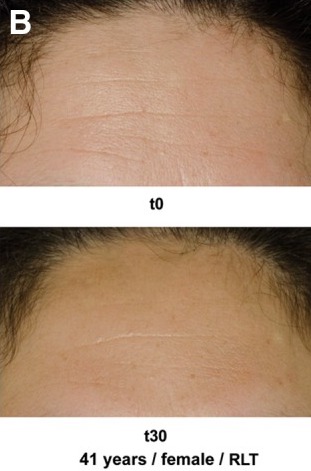
One red light therapy study shows a reduction in wrinkle lines on the forehead.
Photo courtesy Mary Ann Liebert, Inc.

Frequency of Red Light Therapy for Body Contouring

Another popular use of red light therapy is for body contouring. Body contouring is a fancy way of referring to achieving a thinner or slimmer physique. There are a lot of people who want reduced waistlines, hiplines, and thigh circumference.

We will continue to search for information about whether PBM works for weight loss. But the good news is that there has been some research into what happens to fat cells and fatty tissue when exposed to certain wavelengths of red light and near-infrared light.

One interesting study demonstrated the effects of a single, 32 minute treatment on targeted areas of the body in 58 subjects, compared to six treatments with a “hot light” (laser-based liposculpture). In this study, the RLT was coupled with a diet and exercise regime. An average reduction in circumferential measurement of 3.5 inches was achieved after just a single treatment.

A second study conducted in 2018 described testing for a similar reduction in circumferential measurement on protruding areas of fat in 118 subjects. The results of this study have not yet been published, but the details of the study suggest that results are sought on the routine use of 635nm LEDs in sessions of 30 minutes in length.

If true body contouring results are to be achieved, success probably involves using red light therapies in concert with the “tried and true” methods of weight loss: diet and exercise.

If you are seeking weight loss, you should probably plan on frequent red light therapy sessions as well as regular exercise to see the best results.

Frequency of Red Light Therapy for Improved Brain Function

The human brain is perhaps one of the universe’s most complex and fascinating systems. The brain controls thought, emotion, and motor skills. The brain is the organ of the body that makes us unique as living things. Since the human brain is such a complex system, it is no surprise that light energy may affect cell function and deliver benefits.

Red light therapy has generated interest from scientists and consumers concerned about neurological issues. They seek improvements in mood, cognition, attention, and focus. There’s also a desire to help with disorders such as dementia, alzheimer’s disease, depression, and epilepsy.

Factor #2: The Equipment and Devices Used to Administer the Treatment

Your choice of equipment is also an important factor that determines how often you should use red light therapy. Not all products work the same way.

Your success with red light therapy treatment is directly related to how much photonic energy you expose to the affected area of the body. A more powerful device will work better than a less powerful device. The same amount of energy concentrated on a smaller area of the body will work better than focusing on a larger area of the body. More time in front of the light will work better than less light exposure. This is because of the nature of light energy itself.

Note: we will be sharing a dosage guide for beginners of red light therapy soon. Please make sure to join our Facebook group to be notified when it is completed.

Factor #3: Consistency of Your Treatment

Let’s face it. Consistent treatments will always have better results than sporadic use. Red light therapy, how often you use it, and the products used for your treatment won’t achieve the desired results if you’re not using it in a consistent way.

Stick to a Schedule

You are more likely to see positive results if you use your red light therapy device frequently and at around same time of day. Based on our research, people who have had the most success with photobiomodulation have treated themselves daily at the same time each day.

There doesn’t seem to be any evidence that you can overdo it. So don’t be shy. Treat yourself often!

Focus on the Same Problem Areas Every Time

You should also focus your therapy on the same areas of the body in a consistent way. For example, if a particular joint is causing pain, make sure that you treat that joint each and every time. Also, position your body the same way around the device. You should be consistent with your distance from the device as well.

Factor #4: Impact to Your Schedule

Most people don’t have a lot of free time on their hands. This is perhaps one of the most important factors that determines how often you should use a form of low level light therapy.

Earlier in the article we suggested that you can’t overdo it. But there are some things in life that you simply can’t avoid, such as work, school, or caretaking for family members. All of these activities matter to your health and wellness.

Therefore, it is best to find the right schedule for your treatments that don’t impact other important aspects of your life.
What is Red Light Therapy?

Quick Overview of Red Light Therapy

Welcome! If you’ve asked yourself, “What is red light therapy?” or heard about the science of photobiomodulation, then you’ve come to the right place! So, we wrote this beginner’s guide to help you get started on your journey to improved health.

Red light therapy is proven to be effective in treating many health conditions.

Many scientists and doctors recommend using red light for health and wellness. So what does it involve? Red light therapy involves directing specific wavelength combinations of light on living tissue. Accordingly, the medical community and consumers are realizing that malfunctioning tissue can be repaired with red light and near-infrared light.

Also, healthy tissue can be improved with the appropriate doses of red light. It can be targeted on specific areas of the body.

Red light therapy is a form of photobiomodulation. PBM stimulates cellular metabolism. As a result, these stimulated cells grow faster and self-repair. Therefore, when cells are exposed to the correct light, they produce signals that improve blood flow and tell other cells that “it is time to heal”. In layman’s terms, this can help a person’s health in several ways:

  • Helps body tissue recover from injuries faster
  • Slows, reverses, or prevents certain diseases
  • Reduces pain and inflammation
  • Improves bodily functions such as metabolism

Red light therapy is not new. There are many new products available. We’re excited that you’ve begun your journey. And we hope you find comfort and relief.

Why Is Red Light Therapy Interesting?

Red light therapy is appealing to consumers because it is safe and non-invasive. Therefore, it is often contact-free and never involves ingesting anything.

To put it into perspective, it is far safer than an x-ray.

Until recently, you received red light therapy in a clinical environment. Health and medical professionals usually administer treatment with devices that require special training. But the technology has advanced, the cost of the equipment is coming down and the devices are fairly easy to operate. There are many products available for in-home. Therefore, few require any special training or expertise.

Red light therapy has been studied pain management, injury or surgery recovery, and mental health. It has even been studied for hair growth and weight management. Furthermore, the research community is conducting new studies regularly. As a result, red light therapy could be a legitimate option for your health and wellness.

What is Red Light Therapy? A Detailed Explanation

You’ve made it this far. At this point, you may be wondering more about the science behind red light therapy. In this section, we will touch on the scientific and medical concepts in ways that an average person would understand. Please note that we are not doctors or scientists. To be clear, our role is to be an informed consumer. Just like you.

What is Light?

Light is simply a flow of charged sub-atomic particles that travel in harmonious waves of energy. These waves of particles are called “photons”. Just like waves in the ocean, light waves can be very different. Some waves are taller. Others have a lot of space between them. Certain light waves carry a lot of energy. Others barely move you when they run into your body.

How Does a Living Cell Work?

Scientists have called mitochondria the “power plant” of a cell because mitochondria product the energy that cells need to reproduce, repair, and signal other cells to do the same.

Mitochondria produce a chemical called adenisine triphosphate (ATP), which is an energy-rich molecule. You can think of ATP as a kind of fuel that a cell uses to do its job. Cells have all kinds of “jobs” in the body.

Cells Can Generate Energy From Light

Scientists have discovered that certain wavelengths of light will stimulate mitochondria of certain cells in different ways and at different speeds, making light therapy an interesting and powerful way to change how the body works.

By exposing the right kinds of cells to the right forms of light, it is possible to get cells to do what we want them to do. This is what makes light useful for achieving specific health and wellness outcomes.

Research has shown that higher-wavelength light can be effective in therapeutic situations. They can fight infection, repair wounds, and even produce signals to other cells that it is time to start work or speed up the job.

Which Health & Medical Conditions Can Be Treated with Red Light Therapy, Low-Level Laser Therapy, & Photobiomodulation?

At this writing, the list of conditions being studied for treatment by red light therapy is long. Red Light Therapy has been in numerous clinical trials to treat skin, bone, muscle, the brain, joints, and more. This type of therapy has been administered to consumers and patients of clinical professionals to improve sleep habits, reduce anxiety, and improve focus and mental state. And the medical community is active in using this form of non-invasive, non-pharmaceutical therapy to uncover additional health and wellness applications.

Low level laser light therapy and other forms of photobiomodulation could help treat many conditions.

  • Reverses the effects of aging on skin wrinkles, eyesight, and cognitive function
  • Reduces the impact of acne and psoriasis
  • Treats of pigmentary disorders
  • Reduces fat
  • Sharpens mental clarity by improving sleep habits, focus, concentration
  • Treats mental health conditions such as bipolar disorder and depression
  • Accelerates rehabilitation after traumatic brain injury
  • Heals wounds faster, including healing cuts faster and minimizing or reducing scarring
  • Combats side effects of cancer treatments
  • Combats certain cancers such as squamous cell carcinoma

How to Use Red Light Therapy

There are two common ways that individuals can experience photobiomodulation:

In a clinical setting

Initially, the equipment and devices developed for this innovative form of therapy were employed by medically-trained personnel. Those who sought this treatment typically would seek it on a scheduled basis and under the supervision of clinical staff. Check this page often. We intend to share what we learn about interesting examples of clinically-administered red light therapy services.

These days, you can find professional clinics that offer red light therapy for a wide range of health concerns.

At home

The technology behind photobiomodulation therapies has advanced to a point where there are now devices on the market that can be purchased by consumers for use in their own homes. Our evaluation of many of the products advertised on the market indicate that these devices are safe and fairly easy to use.

Is Red Light Therapy Safe?

The US Food & Drug Administration has established a classification system to regulate the use of lasers, as part of a larger mandate to regulate radiation-emitting devices and products. The FDA system for lasers and light-emitting diodes (LEDs) includes four classes, with some sub-classes. The purpose of the classifications is to group products by the hazards possible when using them. The lowest class, which can include products like CD players, is considered non-hazardous. Slightly more hazardous products include laser pointers and barcode scanners. The highest class is reserved for medical and industrial applications, and involve such powerful and focused light that they can result in significant bodily injury or even represent a fire hazard.

Any reputable manufacturer or clinical operator of this technology should be able to articulate how their products conform to the framework outlined by the FDA.